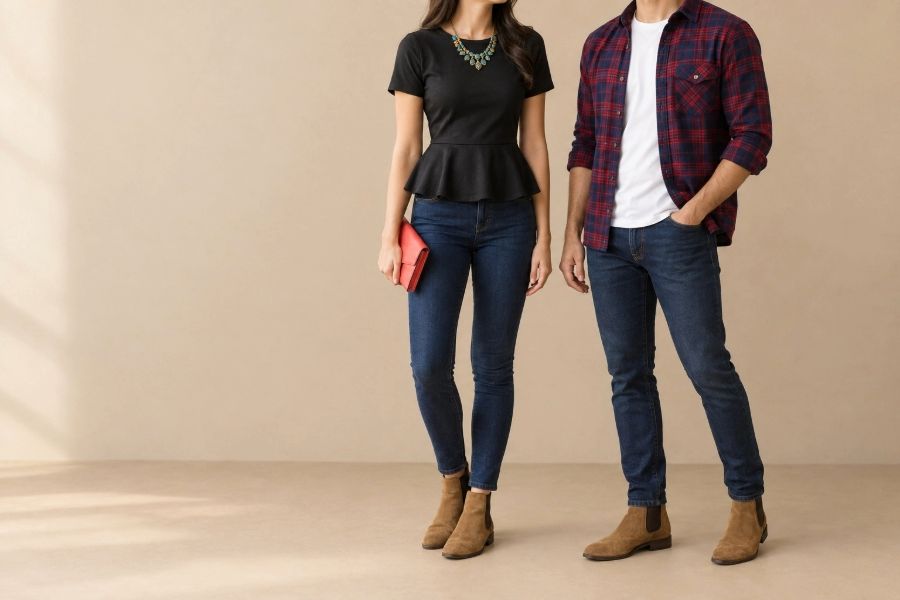
2014 fashion was a turning point. Skinny jeans, peplum tops and statement necklaces were still everywhere, but flannel shirts, bomber jackets, Chelsea boots, normcore basics and the first wave of athleisure showed where style was heading. This guide explains what defined 2014 fashion for men and women, why it’s back, and how to wear it now without looking like a costume.
Quick Answer: 2014 fashion for men and women was defined by skinny jeans, peplum tops, statement necklaces, flannel shirts, bomber jackets and Chelsea boots, alongside neon accents and the rise of normcore and athleisure. It works today when you keep one or two pieces and update proportions, fabrics and accessories.
2014 Fashion: What You Need to Know
The best way to understand 2014 fashion is as a tug-of-war between two forces. One was decoration: bright accents, bold prints, chunky necklaces and dramatically dyed hair. The other was a deliberate move toward plain, comfortable clothes, which arrived that year under the name normcore and, soon after, as athleisure.
Most outfits followed one simple proportion rule: slim below, interest above. Skinny jeans, leggings and slim trousers kept the lower half narrow, while the top half carried the detail, whether that was a flared peplum hem, a checked flannel shirt, a chunky knit or a structured jacket. It is a useful rule to borrow today, because it explains why the era’s outfits look top-heavy next to current relaxed cuts.
One caution before you shop or style: trends overlap, and 2014 sat at the end of a busy stretch. Peplum, for example, had its biggest moment a few years earlier and was familiar rather than new by 2014. Think of the year as a snapshot of the early-2010s wardrobe in transition, not a single tidy uniform.
2014 Fashion at a Glance
Each row shows who wore what: Both, Women or Men.
| Attribute | Details | Why It Matters |
|---|---|---|
| Core silhouette | Both: slim legs with a structured, layered or embellished top half | Explains why the era’s outfits feel top-heavy next to today’s relaxed cuts |
| Signature bottoms | Both: skinny jeans<br>Women: leggings, flared skater skirts, high-waisted jeans<br>Men: slim chinos, dark or light denim | The easiest pieces to update with modern tops and shoes |
| Signature tops | Both: flannel shirts, chunky knits<br>Women: peplum tops, crop tops<br>Men: chambray and printed shirts | Shape and texture, not just color, made these tops recognizable |
| Outerwear | Men: bomber jackets, military-inspired coats<br>Both: layered cardigans and jackets | Layering added bulk on top to balance slim legs |
| Footwear | Both: Chelsea boots, early retro sneakers<br>Women: platform ankle boots, riding boots | Comfortable shoes hinted at the casual shift that followed |
| Accessories | Both: infinity scarves<br>Women: statement necklaces | Accessories dated the look fastest, so choose them carefully today |
| Color and print | Both: neon accents, color-blocking<br>Men: floral, geometric and camouflage prints | Bold color was the quickest way to signal “current” that year |
| The quiet shift | Both: normcore basics and early athleisure | Explains why plain, comfortable outfits already feel familiar |
| Grooming | Women: ombré and dip-dyed hair<br>Men: well-groomed beards | Grooming is often the first thing people notice in a throwback look |
Why 2014 Fashion Is Trending Again
Trends have traditionally returned on a cycle of roughly 20 years, but social media has compressed that, and revivals now often arrive within 10 to 15. The early 2010s are also the first decade documented in enormous detail online, which gives younger shoppers plenty to browse and people who lived through it plenty to feel nostalgic about.
The comeback is visible in specific pieces. Skinny jeans have climbed back in search interest and on runways since early 2025, though still well below their earlier peak, and peplum has returned in softer cotton and subtle blazer-hem versions. Secondhand shopping makes the era easy to explore on a budget.
There is also a deeper reason: several 2014 ideas were early versions of what came next. This short timeline shows how the quiet side of the year took shape:
- October 2013: A trend-forecasting group called K-Hole used the word “normcore” in a report, describing an attitude of finding freedom in being ordinary rather than a dress code.
- February 2014: A widely read magazine feature turned the idea into a wardrobe of plain jeans, fleeces and sneakers, and the term spread quickly.
- 2014: Luxury retail started giving activewear its own dedicated shopping platforms, an early sign that sportswear was moving into everyday dressing.
The 2014 Look: Category-by-Category Breakdown
This is the practical core. Each category covers what defined it, why it worked, and how to wear it now. Look for the Both, Women and Men labels to find what applies to you.
Denim and Trousers
Both: Skinny jeans were the default. A slim leg made bulkier tops and boots look balanced, and the cut worked with almost any shoe.
Women: Leggings, flared skater skirts and high-waisted jeans were the other everyday bottoms, usually with fitted or cropped tops.
Men: Slim chinos were the smart-casual alternative, and denim-on-denim in a range of blues, from light to dark, was a notable idea of the season.
Wear it now: Choose a darker, cleaner wash with little or no distressing, and go for a slim-straight cut if full skinny feels too tight. Pair with a looser top or a longer jacket so the outfit doesn’t read as fitted all over.
Tops and Shirts
Women: Tops were more sculpted. The peplum, a small flared ruffle at the waist, created an instant hourglass shape and was often paired with a pencil skirt or slim trouser. Crop tops were the casual counterpart.
Men: Chambray shirts and slim-fit printed shirts, including florals and geometrics, gave menswear more color than usual.
Both: Flannel shirts were a staple, often worn open over a plain tee.
Wear it now: Choose a peplum in a fluid, matte fabric with a subtle flare, which feels more current than a stiff, shiny one. Wear flannel and chambray in a soft, washed fabric with a relaxed fit.
Outerwear and Knitwear
Men: Bomber jackets were a defining piece, worn in leather, satin or nylon, and military-inspired styles and layering were part of the same push toward more interesting outerwear.
Both: Chunky knits and cardigans added bulk on top, balanced by slim trousers or leggings underneath.
Wear it now: Keep the bomber or the chunky knit, but pair it with a straight or wider trouser to avoid the exact 2014 proportion. A plain tee or fine knit underneath keeps it modern.
Footwear
Both: Chelsea boots were the shared favorite: clean, slim and easy to dress up or down. Retro sneakers began creeping into casual outfits late in the year, hinting at what was coming.
Women: Platform ankle boots and riding boots were everyday choices.
Wear it now: Chelsea boots are the easiest to carry forward because their shape is genuinely timeless. Platforms are the riskiest and look best with simple, uncluttered outfits.
Accessories
Both: Infinity scarves were a cold-weather staple across both wardrobes.
Women: Chunky statement necklaces were worn over plain necklines, which gave the piece room to be the focal point.
Wear it now: Wear one statement item at a time. A single bold piece against a plain base looks intentional, while several together look dated.
Color and Print
Both: Neon appeared mostly as an accent, such as a bright top, a shoe, a bag or a pair of socks, and color-blocking paired two or three solid, contrasting shades in one outfit.
Men: Floral, geometric and camouflage prints showed up on shirts, giving traditionally neutral wardrobes some pattern.
Wear it now: Stay with two colors and choose tones that share an undertone, like warm coral with camel or navy with sand. Save neon for one small accessory.
Normcore and Athleisure: The Quiet Shift
Both: Normcore, as the fashion press described it, meant ordinary basics: plain jeans, simple tees, fleece and comfortable sneakers. Athleisure grew alongside it, bringing leggings, joggers and trainers into everyday outfits.
Women: Leggings and sneakers became normal daywear, not just gym wear.
Men: Sweatpants slimmed down into the jogger, and sneakers started replacing dress shoes in casual outfits.
Wear it now: This is the part of 2014 that never really went away. Pair a plain tee with well-fitting jeans and clean sneakers, and let fabric quality do the work.
Grooming and Hair
Women: Ombré and dip-dyed hair defined the beauty side. The look softened over time from harsh two-tone tips into a gradual fade, and stylists were also offering reverse ombré, softer sombré and bold color.
Men: Well-groomed beards were an important part of the look.
Wear it now: Grooming was more visible and defined than in many current, skin-first looks. Choose a soft, blended color fade rather than a stark line, and keep a beard neatly trimmed.
2014 Fashion Styling Table: Pairing Guide
The label in brackets shows who the piece is for.
| Piece | Best Paired With | Occasion |
|---|---|---|
| Skinny or slim jeans (both) | Oversized knit, long coat or loose shirt | Everyday, casual weekends |
| Flannel or plaid shirt (both) | Dark jeans, plain tee underneath, simple boots | Casual days, cooler weather |
| Chambray shirt (men) | Slim chinos or dark denim, plain sneakers | Smart-casual work, weekends |
| Peplum top (women) | Slim trousers or pencil skirt in a neutral shade | Office, dinner, events |
| Statement necklace (women) | Plain tee, simple crew neck or solid dress | Evening out, brunch |
| Chunky knit (both) | Straight trousers or slim denim, ankle or Chelsea boots | Cold weather, casual days |
| Bomber jacket (men) | Plain tee or fine knit, dark denim | Everyday, weekend outings |
| Chelsea boots (both) | Skinny or straight jeans, chinos, midi skirts | Almost any casual or smart-casual setting |
Common 2014 Fashion Mistakes to Avoid
The biggest mistake is copying a full 2014 outfit from top to bottom. When every piece is from the same era, the result looks like a costume rather than a styled look. Mixing one or two era pieces with current basics almost always works better.
Other errors are easy to spot and easy to fix:
- Too many statement pieces at once (both). The original look relied on one hero item. Stacking scarves, necklaces, bold prints and bright colors together overwhelms the outfit.
- Ignoring fabric quality (both). Thin, stiff or shiny fabrics look cheap in a way that heavier, matte ones don’t. Fabric often matters more than the item itself.
- Wearing skinny jeans with a tight top (both). Fitted on fitted flattens your proportions. Add volume or length somewhere.
- Stiff, shiny peplum tops (women). A rigid ruffle in shiny fabric looks costume-like. Soft, matte fabric reads as modern.
- Overdoing the neon (both). A full neon outfit reads as nostalgic dress-up. One bright accent is enough.
- Treating normcore as a costume (both). The idea was about comfortable, ordinary clothes. Recreating it head to toe misses the point, so keep it to one or two simple pieces.
- Keeping grooming era-exact (both). Even a modern outfit can look dated if the hair, beard or makeup is a perfect 2014 replica.
Who 2014 Fashion Suits and How to Adapt It
The strength of this era is that it works on a wide range of shapes when adjusted properly, and most pieces can be worn by any gender with small tweaks in fit.
- Petite frames (both): Keep slim jeans and choose shorter tops or cropped jackets, which preserve leg length.
- Broader or curvier frames (both): Choose structured fabrics and a mid-rise waist. Straight-leg jeans and slim-straight chinos are more comfortable than very tight skinnies.
- Tall frames (both): Longer knits, relaxed jeans and longer coats suit you well and carry the era’s slouchy side.
- Women: Peplum tops define the waist on straight or rectangular frames, while a lightly flared or A-line version suits those who prefer less emphasis at the hips.
- Men: A flannel or chambray shirt worn open over a plain tee adds shape to the upper body, and slim-straight chinos or jeans keep the leg line clean.
- Budget (both): Secondhand shops and thrift stores are ideal for this era, because many pieces are widely available and easy to find in good condition.
- Seasons (both): In spring and summer, lean on chambray, light prints and color-blocking. In autumn and winter, focus on flannel, knits, scarves, jackets and boots.
- Occasions: Men can wear slim chinos with a plain knit to the office, and women a peplum with a pencil skirt. Both can wear skinny jeans, flannel and chunky knits for casual days.
Conclusion
2014 fashion is easiest to wear when you treat it as a source of ideas rather than a uniform. Borrow the “slim below, interest above” logic, pick one or two era pieces such as Chelsea boots, a flannel shirt, a bomber jacket or a peplum top, and balance them with cleaner, more current basics.
Start small, and pay attention to fabric and proportion. Try one piece from the list above this week and build from there.